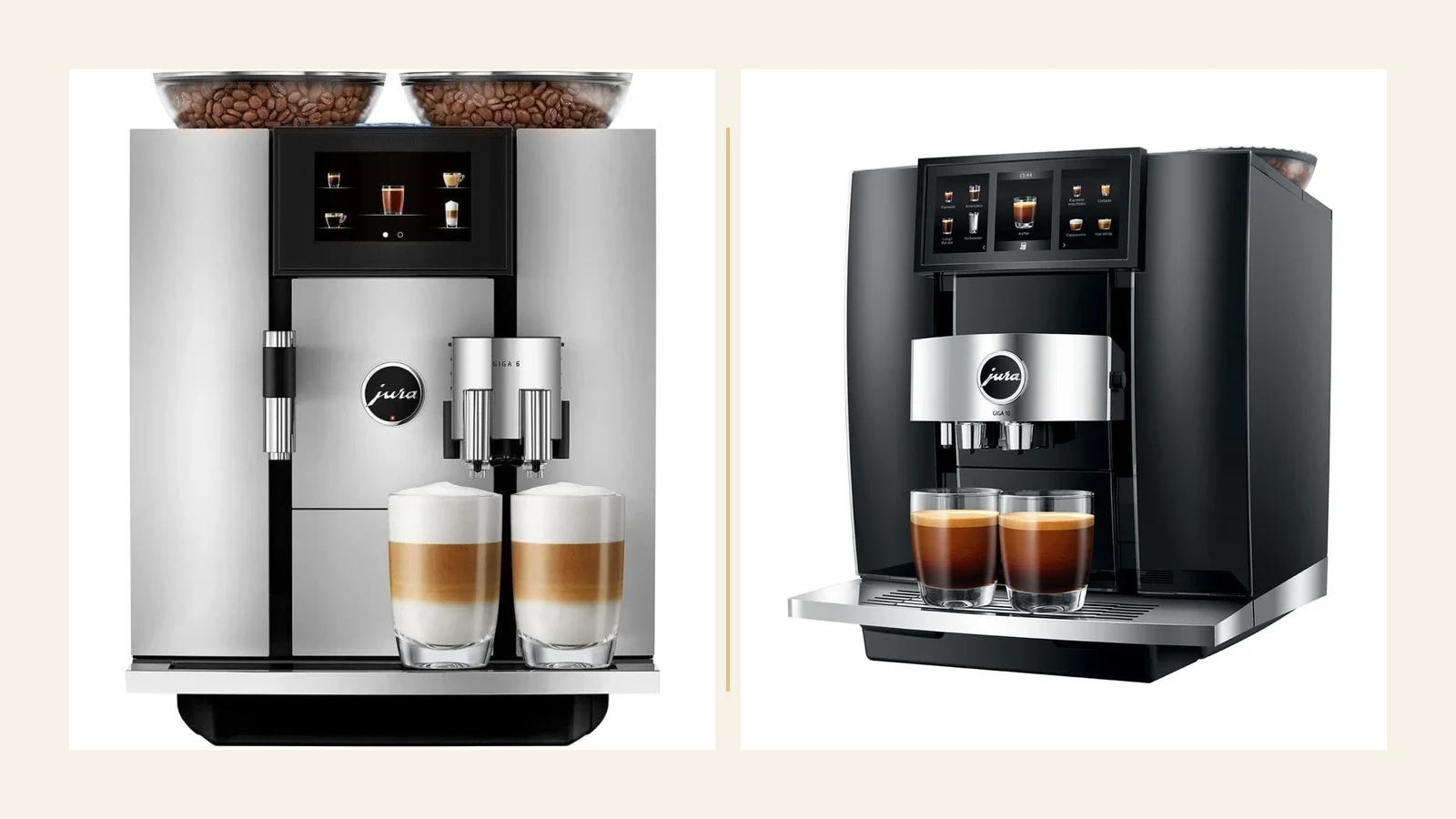
The GIGA 6 and GIGA 10 sit at the top of Jura’s lineup. Both machines feature dual ceramic disc grinders, dual bean hoppers, and dual thermoblock heating systems - hardware you will not find on any other Jura model. They are built for high-volume use, whether that means a busy household, a small office, or a conference room that serves all-day coffee.
The GIGA 10 is Jura’s absolute flagship. It costs about $5,499 compared to about $4,200 for the GIGA 6. That is a gap of roughly $1,300. This guide breaks down what you actually get for the extra money and whether it is worth it for your situation.
Side-by-Side Specs
| Feature | GIGA 6 | GIGA 10 |
|---|---|---|
| Price | ~$4,200 | ~$5,499 |
| Grinders | 2x ceramic disc | 2x ceramic disc |
| Bean hoppers | 2 (280g each) | 2 (280g each) |
| Water tank | 2.6L | 2.6L |
| Drink specialties | 28 | 35 |
| Display | 4.3” TFT color | 4.3” TFT color with product animations |
| Speed Function | No | Yes |
| WiFi / J.O.E. app | No | Yes (WiFi Connect) |
| Daily capacity | 30-40 cups | 40-60 cups |
| Milk system | HP1 fine foam | HP3 fine foam |
| Heating system | 2x thermoblock | 2x thermoblock |
| Front design (per Jura) | 3 mm aluminum frame | Diamond Black front, chrome elements |
| Weight (per Jura) | 39.7 lbs (18 kg) | 39.7 lbs (18 kg) |
| Maintenance status | Standard prompts | Intelligent status display |
| Best for | Home/small office | Medium office/high volume |
What the GIGA 6 Does Well
The GIGA 6’s defining feature is its dual grinder system. Two separate bean hoppers feed two separate ceramic disc grinders. You can load regular beans in one hopper and decaf in the other, then switch between them at the touch of a button - no emptying, no refilling, no cross-contamination.
This alone justifies the GIGA line’s existence. Every other Jura (the E8, S8, Z10) has a single grinder. If you want one-touch switching between regular and decaf, the GIGA is your only option.
Beyond dual grinders, the GIGA 6 delivers:
- 28 drink specialties including espresso, ristretto, flat white, cappuccino, latte macchiato, and hot water
- 4.3” TFT color touchscreen for easy navigation and drink customization
- Dual thermoblock heating so you can brew coffee and steam milk simultaneously without waiting
- 2.6L water tank - larger than the E8’s 1.9L, supporting higher daily volume
- 30-40 cups per day throughput - suitable for a home with heavy coffee consumption or a small office of 5-10 people
The build quality matches the price. The GIGA 6 feels like a professional appliance, with solid construction and quiet operation relative to its output capacity.
What the GIGA 10 Adds
The GIGA 10 takes the GIGA 6’s dual-grinder foundation and layers on features designed for higher throughput and more control.
Speed Function
The GIGA 10’s Speed Function shortens brewing and milk frothing times. For an office serving 40+ cups per day, this matters. Shorter cycle times mean less waiting during morning rushes and meeting breaks. The GIGA 6 is not slow, but the GIGA 10 is noticeably faster when you are making back-to-back drinks.
HP3 Fine Foam vs HP1
The GIGA 10 uses Jura’s HP3 milk system, which offers independent foam density and temperature control per drink. The GIGA 6 uses HP1. The practical difference: the GIGA 10 produces denser, more stable microfoam and lets you fine-tune foam texture for each saved drink profile. If your office has people who want dry cappuccinos alongside others who prefer silky flat whites, HP3 handles both without manual adjustments.
WiFi Connect and J.O.E. App
The GIGA 10 includes WiFi Connect for Jura’s J.O.E. (Jura Operating Experience) app. This lets you start drinks from your phone, save custom drink profiles, and monitor machine status remotely. The GIGA 6 does not have WiFi connectivity.
For an office setting, remote status monitoring is useful - you can see when the drip tray needs emptying or when beans are running low without walking to the machine.
Enhanced Display
Both machines have 4.3” color displays, but the GIGA 10’s screen includes product animations that show each drink being prepared. It also features an intelligent maintenance status display that provides more detailed information about cleaning cycles, filter status, and service intervals.
Higher Daily Capacity
The GIGA 10 is rated for 40-60 cups per day compared to the GIGA 6’s 30-40. The internal components are built for heavier sustained use - important if the machine will run continuously in a busy office environment.
Build Materials: Is the GIGA 10 More Plastic?
Some owners who move from a GIGA 6 to a GIGA 10 report more plastic trim on the new machine. Jura’s own spec pages explain part of this.
- GIGA 6 Aluminum: Jura lists “Alu Frame Design 3 mm” under design and materials. The front frame is aluminum.
- GIGA 10 Diamond Black: Jura lists a Diamond Black front panel with chrome elements and “two-component technology front sections”. It does not mention aluminum anywhere on the page.
So the GIGA 6 Aluminum has a metal front frame, and Jura’s GIGA 10 page names no metal front. That matches what those owners report. Jura does not publish a full material breakdown for either machine, so we cannot say how much of each housing is plastic.
Some facts point the other way. Both machines weigh the same: 39.7 lbs (18 kg), according to Jura. Both use two ceramic disc grinders, which Jura describes as long-lasting. The parts that wear out in daily use (grinders, brewing units, pumps, valves) are inside, and the front material does not change how they work.
If the finish matters to you, look at both machines in a store before you buy. Check these points:
- Front panel: Tap it. Is it metal or a painted or coated surface?
- Drip tray and cup platform: These take the most knocks and cleaning.
- Bean container lids: Open and close them a few times.
- Spout and milk outlet cover: These move each time you set the cup height.
Who Should Buy the GIGA 6
The GIGA 6 makes sense if:
- You want dual grinders at the lowest possible price. The GIGA 6 is the entry point for Jura’s dual-grinder system. No other Jura model offers this.
- Your household has regular and decaf drinkers. One-touch switching between bean types is the primary use case for dual hoppers.
- You run a small office (5-10 people). 30-40 cups per day is plenty for a small team.
- You do not need WiFi or app control. If you are placing the machine in your kitchen, you probably do not need remote monitoring.
- $4,200 is already a stretch. The GIGA 6 is a premium machine at a premium price. The GIGA 10’s extra $1,300 or so needs clear justification.
Who Should Buy the GIGA 10
The GIGA 10 makes sense if:
- You serve 10-20 people daily. The higher daily capacity and Speed Function are built for medium office environments.
- Speed matters. Back-to-back drink preparation during peak hours is noticeably faster on the GIGA 10.
- You want app-based drink customization and monitoring. WiFi Connect is genuinely useful for office managers who need to track maintenance schedules remotely.
- You entertain frequently at home. If you regularly host dinner parties or events where you are making 10+ drinks in a short window, the Speed Function and HP3 foam system earn their keep.
- Foam quality is a priority. HP3 gives you the best microfoam Jura offers - a real difference for latte art and textured milk drinks.
Value Pick
Jura GIGA 6
Dual ceramic grinders, 28 specialties, 4.3” touchscreen. The most affordable way to get Jura’s dual-grinder system.
Check GIGA 6 Price →Premium Pick
Jura GIGA 10
Everything the GIGA 6 offers plus Speed Function, WiFi Connect, HP3 fine foam, and higher daily capacity for offices.
Check GIGA 10 Price →Do You Actually Need a GIGA?
This is worth asking honestly. The GIGA line starts at about $4,200. For most home users, the Jura E8 at around $2,599 is a far better value. The E8 makes excellent espresso and milk drinks with a single P.A.G.2 grinder, and unless you need dual bean hoppers, it covers everything a household needs.
The GIGA machines justify their price in two specific scenarios:
-
You genuinely need dual grinders. If your household or office includes both regular and decaf drinkers, switching beans on a single-grinder machine means emptying the hopper, running purge cycles, and refilling. The GIGA eliminates this entirely. That convenience is real and daily.
-
You need high daily throughput. A single-grinder Jura can handle 10-20 cups per day comfortably. Beyond that, the GIGA’s dual heating system and larger water tank make a measurable difference in uptime and speed.
If neither of those applies, you are paying a significant premium for capacity and features you will not use. Consider putting the savings toward quality beans instead - the single biggest factor in how your coffee actually tastes, regardless of which machine you choose.
Wondering if any Jura is worth the investment? Read our breakdown on whether Jura machines are worth the price for a broader perspective.
Our Recommendation
Need Dual Grinders? Start With the GIGA 6.
The GIGA 6 delivers Jura’s dual-grinder system, 28 specialties, and enough daily capacity for most homes and small offices - for about $1,300 less than the GIGA 10. Only step up to the GIGA 10 if you need WiFi monitoring, Speed Function throughput, or serve 10+ people daily.
Check GIGA 6 Price on Amazon →Frequently Asked Questions
Does the GIGA 10 use more plastic than the GIGA 6?
On the outside, it can look that way. Jura lists the GIGA 6 Aluminum with a 3 mm aluminum frame design (Alu Frame Design). For the GIGA 10, Jura lists a Diamond Black front with chrome elements and two-component technology front sections, and it does not mention aluminum. Jura does not publish a full material breakdown for either machine. Both weigh about 18 kg (39.7 lbs), and both use two ceramic disc grinders.
As an Amazon Associate, we earn from qualifying purchases at no extra cost to you.