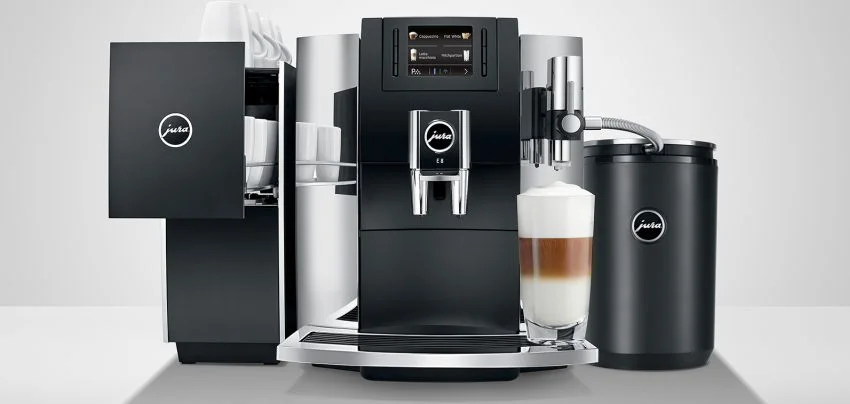
The Jura E8 vs KitchenAid KF8 debate is one of the most active comparisons on r/superautomatic right now, and the price gap is the reason: the KF8 undercuts the E8 by hundreds of dollars while matching it on paper in several categories. This comparison cuts through the brand-loyalty noise on both sides to look at what actually matters - where the KF8’s price advantage is real, and where the E8 earns its premium.
What Does the KF8 Actually Cost Right Now?
The KF8 has listed around $1,700 on Amazon and has been seen at about $1,000 on deal sites during promotions, against about $2,599 list for the E8 - check the current listing for today’s figure, because KF8 pricing moves often and the launch-era $1,999.99 MSRP no longer reflects the street price. That makes the gap between the two machines anywhere from roughly $900 at typical prices to over $1,500 when the KF8 is on deal. At those numbers, the KF8 is genuinely the budget option in this head-to-head, and the question becomes whether the E8’s milk system and service network justify the premium.
| Machine | Typical US Price | Notes |
|---|---|---|
| Jura E8 | About $2,599 list | Occasional $100-200 promo drops |
| KitchenAid KF8 | Around $1,700 on Amazon; seen near $1,000 on deal sites | Check the current listing - moves often |
Better Foam, Proven Longevity
Jura E8 (about $2,599 list)
HP3 fine-foam, 27 specialties (5th-gen), G3 grinder. 5+ years of owner data, Jura professional service network for 15-20 year lifespan.
Check E8 Price →Lower Price, Non-Dairy Mode
KitchenAid KF8 (around $1,700 - check listing)
Dedicated non-dairy mode, removable brew group, finer grind adjustment. Newer to market - less long-term reliability data.
Check KF8 Price →Head-to-Head Comparison
| Feature | Jura E8 | KitchenAid KF8 |
|---|---|---|
| US Price | About $2,599 list | Around $1,700 on Amazon (check listing) |
| Specialties | 27 (5th-gen) | 15+ |
| Grinder | Aroma G3 (6-step) | 15-step conical burr |
| Milk system | HP3 fine-foam | Automatic + non-dairy mode |
| Non-dairy milk mode | No | Yes (dedicated setting) |
| Cold brew | No (Z10 territory) | No |
| Display | 3.5” color TFT | Color touchscreen |
| Professional service network | Yes (20+ years) | Limited (newer brand) |
| Long-term parts availability | Confirmed 10-15+ years | Unconfirmed |
| Launched | 2019 (5th gen 2026) | 2023 |
Coffee Quality
Both machines use conical burr grinders and produce espresso at a competitive level. The KF8’s grinder offers finer-grained adjustment than the Jura E8’s 7-step P.A.G.2 - useful if you rotate between bean types frequently or prefer to dial in precisely.
Jura’s P.E.P. (Pulse Extraction Process) optimizes ristretto and espresso extraction by pulsing water through the puck. The KF8 has its own extraction optimization. Side-by-side, experienced tasters report the difference is subtle - both produce shots that most home users would consider excellent.
Winner on espresso: KF8 on grind precision; E8 on extraction optimization consistency. Practical difference is minimal for most users.
Milk Foam - The Biggest Differentiator
This is where the E8 pulls ahead. Jura’s HP3 fine-foam system consistently produces silkier, more textured microfoam than the KF8’s automatic frothing system. If you make cappuccinos or flat whites daily, the E8’s milk quality is noticeably better in direct comparisons.
However - the KF8’s dedicated non-dairy milk mode is a genuine Jura weakness. The KF8 adjusts frothing temperature and pressure for oat, almond, and soy milk automatically. The Jura E8 froths barista oat milk adequately but requires temperature adjustment, more frequent milk circuit cleaning, and produces less consistent results compared to the KF8’s optimized plant milk mode.
Winner on dairy milk foam: Jura E8. Winner on non-dairy flexibility: KitchenAid KF8.
If your household uses oat or almond milk as the primary milk, the KF8’s dedicated mode is a meaningful functional advantage, not just a marketing feature.
Owners Who Switched From a Z10 to a KF8: What They Report
A recurring thread in owner communities is Jura flagship owners - Z10 owners in particular - trying the KF8 and reporting back, and their reports split cleanly on one point: espresso body. Jura’s brewing process aerates the shot, producing a lighter body with a thick crema layer; the KF8 does not aerate the same way, and some switchers prefer its denser, more traditional-feeling shot while others miss the Jura texture immediately. The two camps rarely convince each other, which suggests this is taste, not a defect on either side.
Two other consistent notes: the KF8 has no cold-brew function, so Z10 owners who used cold extraction regularly report missing it - nothing in the KF8’s menu replaces it. And price is the reason most switchers cite for trying the KF8 at all: at hundreds of dollars below a Jura flagship, several report treating it as a low-risk experiment rather than a committed replacement. If you are cross-shopping at the flagship level rather than the E8 level, our Jura Z10 review covers what the KF8 would be replacing.
Total Cost of Ownership
This is the calculation most buyers skip and later regret.
Jura E8 over 10 years:
- Purchase: about $2,599 list
- Jura professional service (recommended every 2-4 years at ~$400): $1,000-$2,000
- Cleaning tablets (~$25/year): $250
- CLARIS filters (~$100/year via the Smart+ 6-pack): $1,000
- Total: roughly $4,850-$5,850 over 10 years
KitchenAid KF8 over 10 years:
- Purchase: around $1,700 (check the current listing)
- Service costs: Unknown - KitchenAid’s professional service network for the KF8 is not yet established. No published service program comparable to Jura’s
- Cleaning/filters: ~$650
- Total: roughly $2,350 minimum + unknown service costs
The KF8 wins clearly on upfront and near-term cost. The real open question is longevity: if the KF8 needs replacement in 5-7 years, its total 10-year cost converges with the E8’s once a second purchase is factored in. If it matches Jura’s 15-20 year service life, it stays far cheaper per year of use - but that’s unproven for a 2023-launched machine.
The honest answer: The KF8 is the budget pick here and the discount is real. What you are paying for with the E8 is documented longevity, a professional service network, and the best automatic dairy foam in this bracket - not a lower price.
Repairability
Jura machines have been serviced professionally since the 1980s. Jura US and certified Jura repair centers have experience with machines across 3-4 generations. Parts are available. The E8 can realistically be maintained for 15-20 years.
The KF8 is a 2023 machine. KitchenAid’s long-term parts commitment for this model is unconfirmed. This is not a knock on the KF8’s build quality - it is simply a fact that 3 years of market presence cannot provide the same long-term data that Jura’s 15+ year service history offers.
Who Should Buy Each
Buy the Jura E8 if:
- You make dairy milk drinks daily and want the best automatic foam quality
- You plan to keep the machine for 10+ years and want a professional service option
- Brand support and parts availability over time matter to you
- The several-hundred-dollar premium is acceptable for those guarantees
Buy the KitchenAid KF8 if:
- Price matters most - it undercuts the E8 by roughly $900 at typical prices, more on deal
- Your household primarily uses oat, almond, or soy milk - the dedicated non-dairy mode is a genuine functional advantage
- You want a removable brew group you can rinse yourself, rather than Jura’s fixed self-rinsing design
- You want finer grind adjustment than the E8’s 7-step P.A.G.2
The Bottom Line
E8 for dairy foam and longevity. KF8 for price and plant milk.
The E8’s HP3 fine-foam and 15-20 year service life earn its premium for committed dairy-drink households. The KF8 delivers most of the experience for hundreds less, with the better plant-milk mode.
See also: Jura E8 Full Review | Jura vs DeLonghi Comparison | Can Jura Use Oat Milk? | Best Jura Espresso Machine