Our complete guide to choosing a Jura espresso machine. We break down every series, explain the features that actually matter, and help you match a model to your daily routine and budget.
Understanding the Jura Lineup
Jura organizes its machines into distinct series. Each series targets a different use case and price range.
| Series | Price Range | Best For | Key Models |
|---|---|---|---|
| ENA | $600-$900 | Compact spaces, light use | ENA 4, ENA 8 |
| D-Series | $800-$1,000 | Budget home use | D6 |
| E-Series | $1,000-$2,000 | Most home buyers | E6, E8 |
| S-Series | $2,000-$2,500 | Premium home | S8 |
| Z-Series | $2,500-$3,500 | Enthusiasts, cold brew | Z10 |
| GIGA | $4,000-$5,500 | Offices, cafes | GIGA 6 |
For most home buyers, the E-Series is the sweet spot - strong features, proven reliability, and reasonable pricing. See our E-Series comparison for a detailed breakdown.
Features That Actually Matter
Not every spec on the product page matters equally. Here are the features worth paying for.
Grinder Quality
The grinder determines espresso quality more than any other component. Jura offers two grinder types:
- Aroma G3 (E6, E8, S8) - Steel burr grinder that is quieter and more consistent than competitors. Excellent for daily use.
- P.R.G. (Z10) - Product Recognizing Grinder that automatically adjusts grind size per drink type. The best grinder in any super-automatic.
Milk System
If you make lattes, cappuccinos, or flat whites, the milk system matters:
- Basic frothing (D6, E6) - Makes decent foam for cappuccinos. Coarser texture.
- Fine-foam technology (E8, S8, Z10) - Produces silky microfoam closer to what you get at a specialty cafe. Worth the upgrade if you drink milk drinks daily.
Display and Interface
- Text displays (older models) - Functional but harder to navigate.
- Color TFT (E6, E8) - Clear icons, easy to use.
- 4.3” touchscreen (S8, Z10) - The best interface in the Jura range. Faster navigation, easier customization.
Drink Count
More drinks means more flexibility, but most people settle on 3-5 favorites. Do not overpay for 32 drinks if you only make espresso and cappuccino.
| Drinks Needed | Recommended Model |
|---|---|
| Espresso + Americano only | D6 or E6 |
| + Cappuccino, latte | E8 |
| + Flat white, cortado, specialty | S8 or Z10 |
| + Cold brew | Z10 only |
Step-by-Step Buying Process
- Set your budget. Jura ranges from $600 to $5,500. The best value sits between $1,000 and $2,000 (E-Series).
- Decide on milk drinks. If you make milk drinks daily, budget for an E8 or higher with fine-foam technology. If you only drink black coffee, the E6 or D6 will serve you well.
- Check your counter space. Measure before you buy. ENA models are the most compact; GIGA machines are large.
- Compare models side by side. Use our comparison pages to see specs in detail.
- Read the review. Check our in-depth reviews for real-world impressions, not just spec sheets.
- Factor in ongoing costs. Budget $50-100 per year for cleaning tablets, descaling solution, and water filters.
Common Buying Mistakes
- Overspending on drink count. If you make espresso and cappuccino daily, the E8’s 17 drinks is more than enough. You do not need 32.
- Ignoring the milk system. The difference between basic frothing and fine-foam technology is significant. Do not buy a cheap model and expect cafe-quality lattes.
- Skipping water filtration. Hard water shortens machine life. Use a CLARIS filter or filtered water from the start.
- Buying without measuring. Jura machines need clearance above for the bean hopper and behind for ventilation.
Which Jura Coffee Machine Should You Buy?
Buy based on two questions: how much milk you drink and how much counter space you have. Daily latte or cappuccino drinkers should buy the Jura E8 ($1,100-1,300 street price) for its fine-foam milk technology; black-coffee drinkers save money with the E6 or, in tight kitchens, the compact ENA 4. Spend up on the S8 for the touchscreen or the Z10 if you want cold brew, and choose the GIGA 6 only for office-level volume. If you are still torn between models, answer a few questions in our Machine Finder for a personalized pick, or work through the step-by-step process above.
Which Jura Machine Is Best for a First-Time Buyer?
For most first-time buyers, the Jura E8 is the best starting point: it covers every common drink (espresso, cappuccino, latte, flat white), uses the same Aroma G3 grinder found in pricier models, and sits in the $1,100-1,300 street-price range where Jura’s value peaks. If you drink mostly black coffee, the Jura E6 delivers identical espresso quality for a few hundred dollars less. Buyers who want the smallest possible footprint should look at the ENA 4 instead. Our first-time buyer’s guide walks through the full decision, but the short version is: buy for the drinks you actually make daily, not the longest menu.
Should You Buy the Jura E6 or Spend More on the E8?
Buy the E6 if you drink espresso, coffee, and the occasional cappuccino; buy the E8 if milk drinks are a daily habit. Both machines share the same grinder and brewing system, so straight espresso tastes the same from either. The E8 adds fine-foam milk technology, a larger drink menu (17 vs 11), and one-touch milk system rinsing, which matters a lot when you froth milk every morning. The typical street-price gap is $300-500. Our full E6 vs E8 comparison breaks down every difference, and the best Jura under $2,000 roundup puts both in context against the S8.
Is a Jura Worth the Money Over a Cheaper Super-Automatic?
A Jura is worth the premium if you value quiet operation, self-maintaining convenience, and long service life; it is not worth it if your priority is the lowest cost per latte. Compared with budget super-automatics, Jura machines grind more quietly, dose up to 16 grams of coffee per shot (many rivals max out near 10), and automate milk-circuit cleaning so daily upkeep takes seconds. The tradeoff: the brew group is sealed and not user-removable, so you rely on Jura’s built-in cleaning programs rather than weekly disassembly. We weigh the full argument in is Jura worth the price and in our Jura vs De’Longhi comparison.
How Long Does a Jura Machine Last?
A well-maintained Jura typically lasts 7-10 years, and many owners report longer with consistent care. The three habits that decide lifespan are running the cleaning cycle when prompted, descaling on schedule (or using CLARIS filters so descaling is rarely needed), and never brewing with very hard unfiltered water. Jura backs new machines with a 2-year warranty in the US, and its sealed brew group is designed to be serviced by Jura rather than replaced by the owner. For a detailed breakdown of lifespan by model tier and usage level, see how long Jura machines last and our CLARIS filter guide.
Is a Refurbished Jura Worth Buying?
Yes, a factory-refurbished Jura is one of the smartest ways into the brand: savings typically run 30-50% off retail, and Jura-certified refurbished units are tested and sold with a 1-year warranty (versus 2 years on new). The key is buying certified stock from an authorized refurbisher, not a used machine from a private seller with unknown maintenance history. Avoid any refurbished unit sold without at least a 1-year warranty. We list the reliable sources and what to check before ordering in where to buy a refurbished Jura.
What Is the Cheapest Jura Machine Worth Buying?
The ENA 4 is the cheapest Jura we recommend, at roughly $600-900 depending on finish and promotions. It makes only black drinks (espresso, coffee, americano) with no milk system, but the espresso itself comes from the same Swiss engineering as the flagship models. If you need milk drinks at the lowest price, step up to the D6 for basic frothing or the E6 for better value long-term. Skip discontinued IMPRESSA-era models sold cheap online: parts and support are harder to get, and a certified refurbished current model is usually the better deal at the same price.
Our Top Recommendations
- Best for most buyers: Jura E8 - the best balance of features, quality, and price
- Best on a budget: Jura E6 - same grinder as the E8, fewer drink options
- Best premium: Jura Z10 - cold brew, P.R.G. grinder, 32 drinks
- Best for offices: GIGA 6 - two grinders, two heating systems, built for volume
Check Current Prices
As an Amazon Associate, we earn from qualifying purchases at no extra cost to you.
Ready to Choose?
Use our Machine Finder for a personalized recommendation, or browse reviews by price tier to find the best model for your budget.
Back to all guides | See also: First-time buyer’s guide | Reviews | Comparisons
Recommended Picks
High-intent options based on this buying guide.
As an Amazon Associate, we earn from qualifying purchases at no extra cost to you.
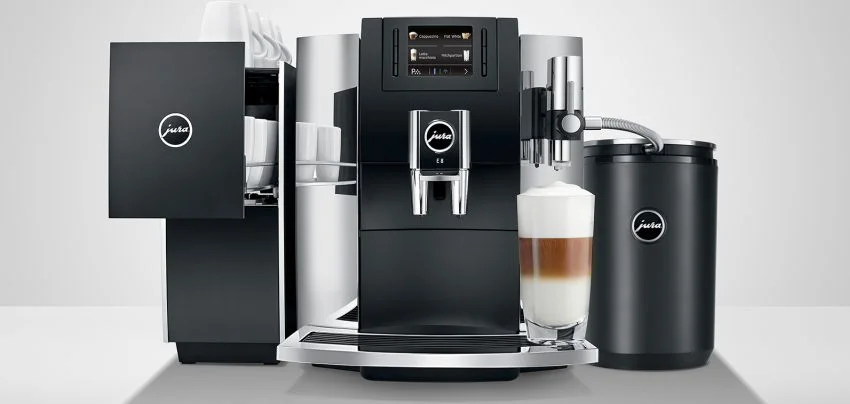
Jura E8
Best balance of price, drink quality, and everyday usability for most buyers.
View on Amazon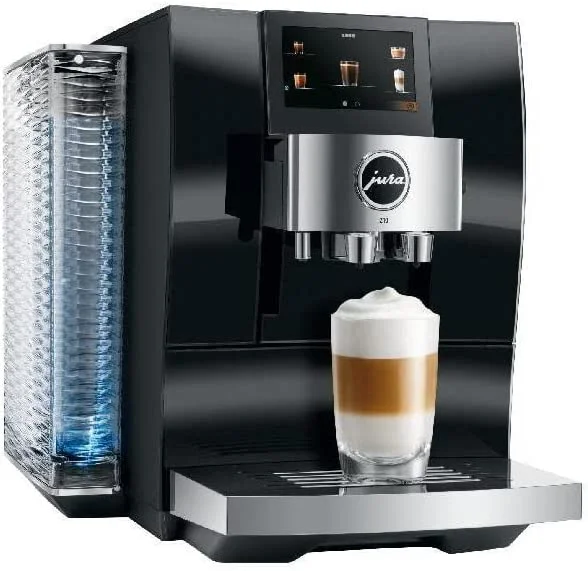
Jura Z10
Premium upgrade if you want one-touch cold coffee and the broadest drink menu.
View on Amazon
Jura ENA 4
Simpler and more compact entry point for black-coffee-first households.
View on Amazon